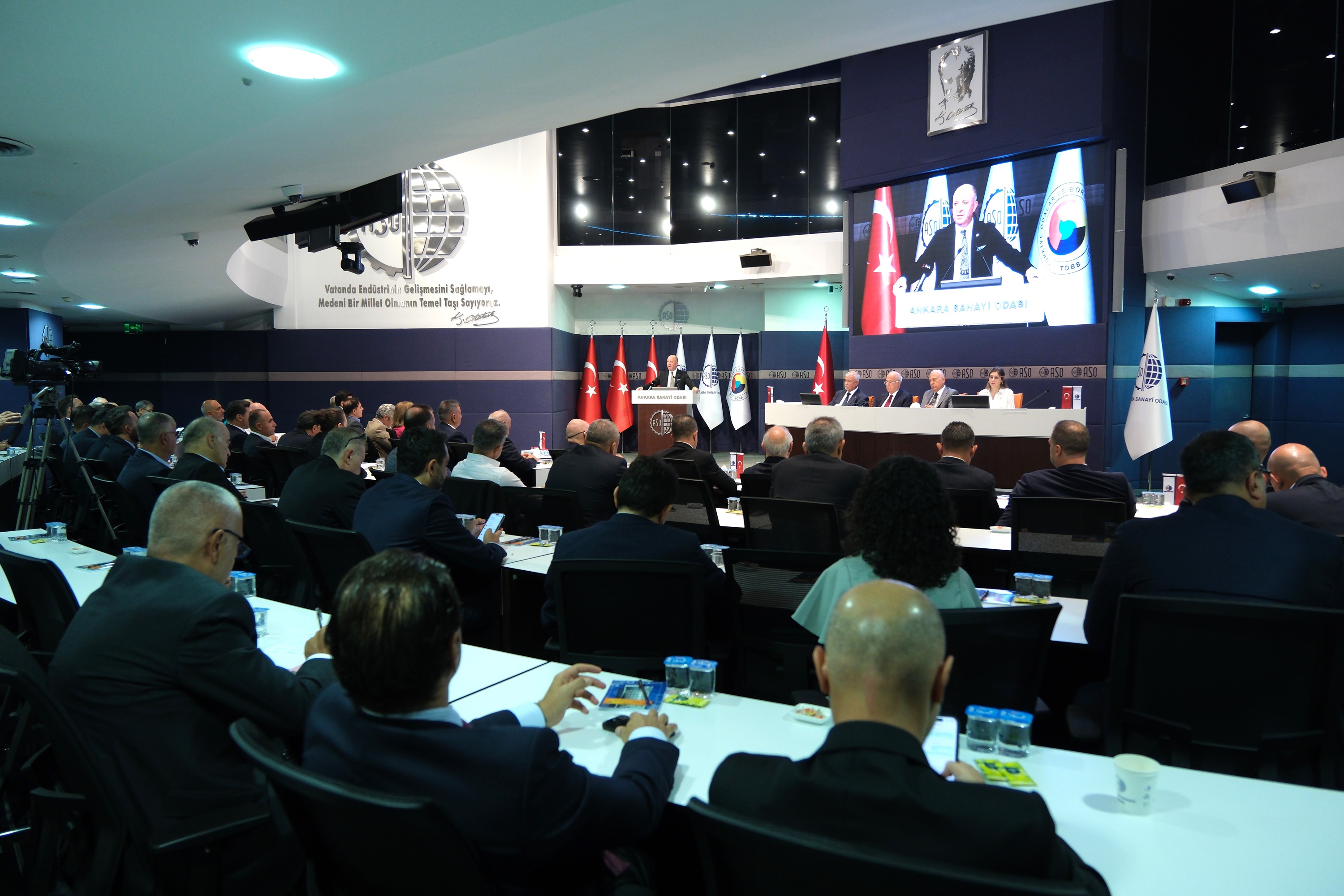
ANKARA CHAMBER OF INDUSTRY AUGUST ASSEMBLY MEETING HELD
ACI CHAIRMAN SEYİT ARDIÇ:
“WE MUST NOT LOSE PRODUCTION STABILITY WHILE TRYING TO ACHIEVE PRICE STABILITY”
“WE CANNOT ALLOW THE DISINFLATION PROGRAM TO TURN INTO DEINDUSTRIALIZATION”
“OUR INDUSTRIALISTS ARE NOT CALCULATING HOW TO MAKE NEW INVESTMENTS, BUT HOW TO SURVIVE”
“INCENTIVES SHOULD NOT BE TEMPORARY SUPPORT THAT KEEPS BUSINESSES AFLOAT, BUT AN INDUSTRIAL POLICY THAT PREPARES THEM FOR GLOBAL COMPETITION”
“WE MUST TRANSFORM TODAY’S STRONG SUPPLIER COMPANIES INTO TOMORROW’S PRODUCT-OWNING COMPANIES”
ACI Chairman of the Board Seyit Ardıç evaluated current economic developments and their effects on industry in his opening speech at the meeting. Stating that a more balanced policy mix is needed in the fight against inflation, one that prioritizes production and exports, Chairman Ardıç said, “We cannot allow the disinflation program to turn into deindustrialization. Today, our industrialists are not calculating how to make new investments, but how much longer they can endure these difficult conditions and how they can survive. We must not lose production stability while trying to achieve price stability.”
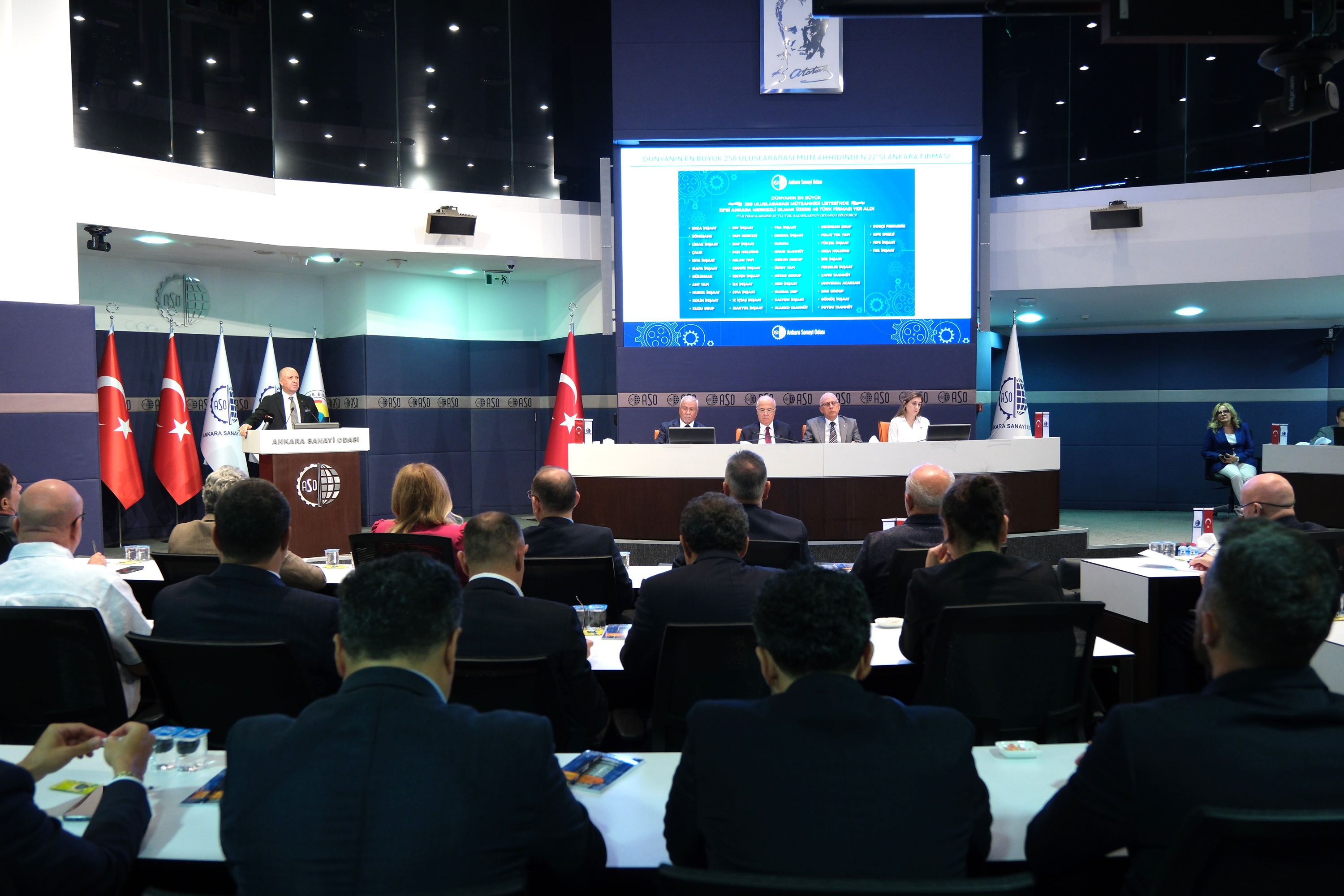
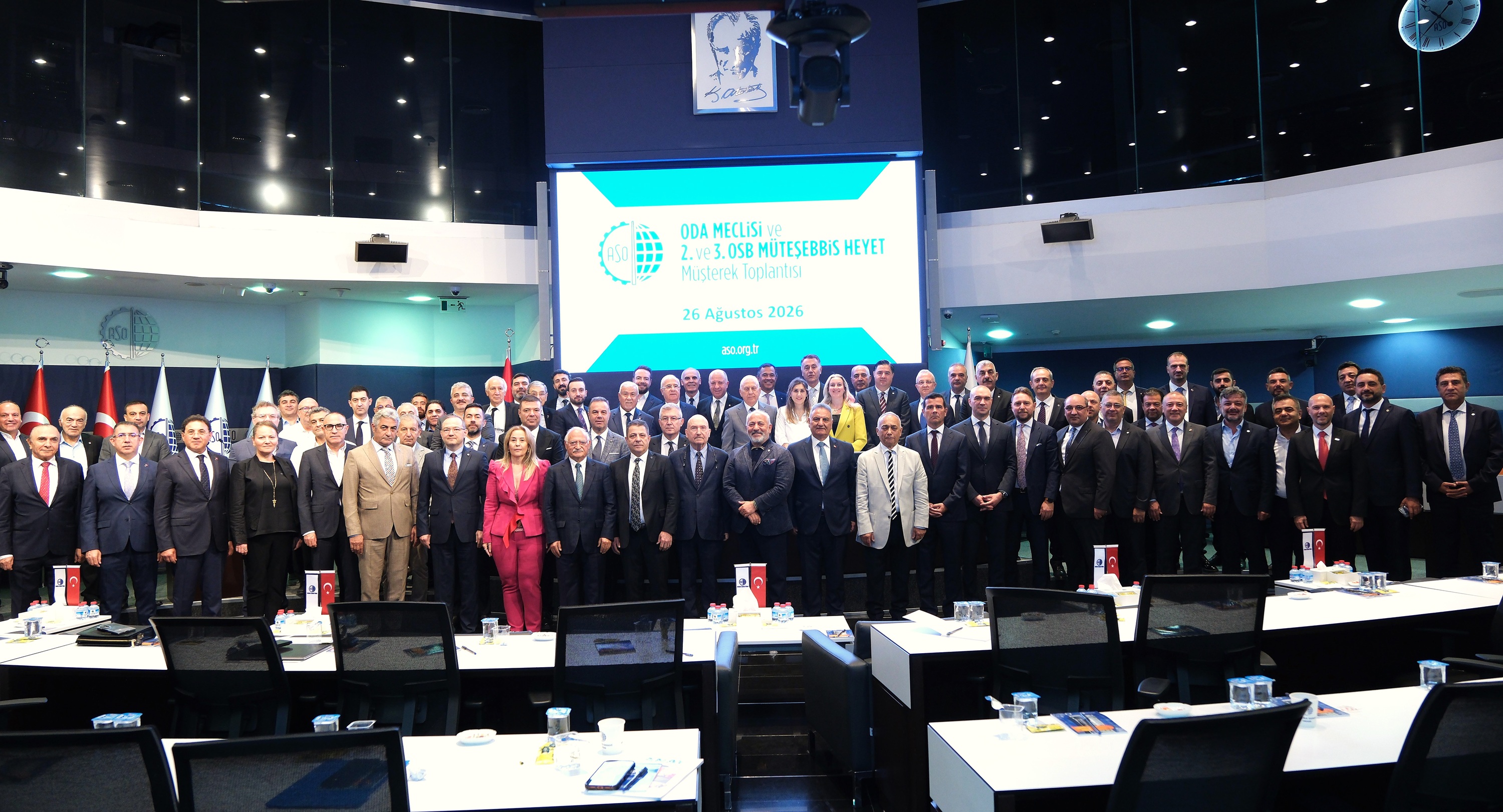
The August Assembly Meeting of the Ankara Chamber of Industry (ACI) was held under the chairmanship of ACI Assembly President Celal Koloğlu. Speaking at the meeting, ACI Chairman of the Board Seyit Ardıç evaluated key issues on the industrial agenda, ranging from changes in global industrial policies to Türkiye’s support system, from the effects of the fight against inflation on industry to the risk of deindustrialization, and from Ankara’s production structure to NATO’s new procurement order.
Reminding that the meeting was held on August 26, the anniversary of the Victory of Manzikert and the beginning of the Great Offensive, Chairman Ardıç said, “We made these lands our homeland with the victory won by Sultan Alparslan at Manzikert, and sealed them forever as our homeland with the Great Offensive launched under the command of Gazi Mustafa Kemal Atatürk. I wholeheartedly celebrate the 955th anniversary of the Victory of Manzikert and the 104th anniversary of the Great Offensive, which showed that our nation, even under the most difficult conditions, never lost its faith and marched toward its goal with great determination and resolve.”
22 OF THE WORLD’S TOP 250 CONTRACTORS ARE FROM ANKARA
In his speech, Chairman Ardıç also referred to the ENR 2026 list of the “World’s Top 250 International Contractors,” stating that the number of Turkish companies on the list increased from 45 to 48, and that 22 of these companies are headquartered in Ankara. Noting that Kolin İnşaat, the company of ACI Assembly President Celal Koloğlu, rose from 129th to 101st place, while Onur Taahhüt, the company of ACI Board Member İhsan Çetinceviz, rose from 166th to 161st place, Chairman Ardıç said, “This achievement is a separate source of pride for us. Our overseas contracting services sector continues to strengthen year by year. I sincerely congratulate all our companies, executives and employees who make great contributions to our country’s economic strength, and I wish them continued success.”
“STATES ARE ENTERING THE FIELD AS INVESTORS, FINANCIERS AND STRATEGIC GUIDES”
Stating that countries’ industrial policies have entered a new phase and that incentive systems have become more selective and proactive, Chairman Ardıç said that the IMF study titled “Industrial Policy and Trade Tensions in Strategic Sectors,” published in July, confirms this change.
Chairman Ardıç said, “States are moving beyond being regulators; they are entering the field as investors, financiers and strategic guides. Target-oriented industrial policies such as strategic incentives, long-term and low-cost financing, and public procurement have today become fundamental tools of global competition.”
Noting that the defense industry, cybersecurity, satellite and radar systems have gained strategic importance in terms of national security; semiconductors, artificial intelligence, robotics and quantum technologies in terms of economic and technological superiority; and batteries, electric vehicles, solar panels and hydrogen technologies in terms of energy transformation, Chairman Ardıç continued: “The competition between countries has gone beyond producing more goods and exporting more. The real competition is now about developing the critical technologies of the future, maintaining their production infrastructure and directing global value chains.”
THE KEY ISSUE IS TO IDENTIFY STRATEGIC SECTORS
Chairman Ardıç stated that the most striking example of this transformation is China, explaining that the country has increased its competitiveness through strategic sector selection, long-term financing, public procurement and technology-oriented company development policies. Noting that China systematically grows medium-sized companies producing critical intermediate goods and technologies through its “Little Giants” program, Chairman Ardıç said that according to OECD data, Chinese firms received on average three to eight times more public support than their competitors in OECD countries during the 2005-2024 period. He emphasized that the financing provided by public banks, tax advantages, export supports and direct public investments transformed these companies into strong actors in global supply chains, and that this approach lies behind China’s production strength in solar panels, lithium batteries, electric vehicles, critical minerals and electronic intermediate goods.
Chairman Ardıç continued as follows:
“While 22 percent of global market share gains can be explained by subsidies, this rate reaches 60 percent among Chinese companies. The message this model gives us is clear. Industrial policy is not merely a general incentive system that distributes support equally to all firms. What matters is to identify strategic areas for the future of the country and to grow companies that have the capacity for technology development, productivity, exports, localization and qualified employment through long-term and performance-based instruments. Incentives should not be temporary support that keeps businesses afloat, but an industrial policy that prepares them for global competition, forces technological progress and produces results.”
Emphasizing that Türkiye needs to establish an original model suited to its own production structure, financing opportunities and foreign trade relations, Chairman Ardıç said, “When rebuilding the support system, we should now ask the question ‘where are we giving it?’ before asking ‘how much are we giving?’ Today, support is spread across a very broad area, but it does not create sufficient weight in any sector. However, success is not about reducing the costs of individual companies one by one, but about making the entire sector competitive by accumulating production power and scale in specific areas.”
“WE MUST SET THE DIRECTION WHILE PROVIDING BREATHING SPACE”
Drawing attention to the scale problem in the current support system, Chairman Ardıç continued:
“We encourage companies to grow; but when a company gains scale, we cut its support. Just when power begins to accumulate, the system withdraws its hand. Strategic areas should be determined jointly by the public and private sectors, and performance should decide which companies will be supported in those areas. Support for businesses that grow, invest and increase exports should not be cut; it should continue in return for growth and export commitments.”
Stating that industrialists are struggling with high financing costs, long collection periods and shrinking demand, Chairman Ardıç said, “For this reason, we must move forward on two tracks at the same time: on the one hand, we must provide businesses with temporary breathing space; on the other, we must establish a selective support system starting today. In short, it should not be first breathing space and then direction; we must set the direction while providing breathing space.”
“INDUSTRIALISTS ARE PAYING THE HEAVIEST PRICE IN THE FIGHT AGAINST INFLATION”
Recalling that a disinflation program based mainly on tight monetary policy has been implemented in Türkiye since mid-2023, Chairman Ardıç stated that the decline in annual inflation from 75 percent in May 2024 to around the 30 percent level is an important achievement. However, he noted that the current level is still slightly above the level recorded at the beginning of the year and that the decline over the past year has remained below two points.
Chairman Ardıç said, “We industrialists are paying the heaviest price in the fight against inflation. While goods inflation has declined to around 27 percent, services inflation remains close to 40 percent. However, service items such as rent, logistics, insurance and consultancy are also part of our costs. This is where the gap opens.”
Emphasizing that the fight against inflation cannot be abandoned, but that the disinflation process must not be allowed to turn into deindustrialization, Chairman Ardıç said, “Today, our industrialists are not calculating how to make new investments, but how much longer they can endure these difficult conditions and how they can survive. We must not lose production stability while trying to achieve price stability.”
Stating that a more balanced policy mix is needed in the fight against inflation, one that prioritizes production and exports, Chairman Ardıç said, “This struggle cannot be limited to the Central Bank’s interest rate policy. Public expenditures, tax policy, administered and guided prices, and expectation management must be carried out in strong coordination with monetary policy. It is of great importance that monetary policy be made simpler and more predictable and that the monetary transmission mechanism be strengthened.”
87 LIRAS OF EVERY 100 LIRAS EARNED BY INDUSTRIALISTS GOES TO FINANCING
Stating that June data showed the continued weakness in the main trend of industry, Chairman Ardıç recalled that manufacturing industry production declined by 1.5 percent, while the seasonally and calendar-adjusted monthly increase remained at 0.1 percent. Drawing attention to the 4.8 percent annual decline in capital goods production, Chairman Ardıç said, “This picture tells us that tomorrow’s capacity is also slowing down, alongside today’s production.”
Evaluating the results of the ISO Second Top 500 Industrial Enterprises Survey, Chairman Ardıç said that despite a 25.7 percent nominal increase in sales from production, real growth remained limited to two per thousand. Chairman Ardıç said, “After three years of real contraction, our industrialists are struggling not to grow, but to maintain their current production level.”
Emphasizing that the most striking result of the survey was the financing burden, Chairman Ardıç said, “Financing expenses increased by 45 percent and reached 138 billion liras, consuming 87 percent of operating profit. Our industrialists had to allocate 87 liras of every 100 liras they earned from operations to financing expenses. The same ratio is 85 in the First 500. In other words, the burden does not ease as scale decreases.”
Comparing the loss of strength in industry to “an illness without fever,” Chairman Ardıç said, “The chimneys are smoking, shifts continue, orders are coming in; however, the resilience of the production structure is gradually weakening. The problem is not a sudden halt, but a silent loss of strength that erodes the investment capacity, productivity and competitiveness of industry over time.”
DEINDUSTRIALIZATION WARNING FROM CHAIRMAN ARDIÇ: IS TÜRKİYE MOVING AWAY FROM THE PRODUCTION ECONOMY?
Chairman Ardıç recalled that he first issued his warning on deindustrialization two years ago, in September 2024, from the ACI Assembly podium, and that he has repeatedly drawn attention to this risk since then.
Stating that the share of industry in national income rose from 19.6 percent in the first quarter of 2016 to 22.8 percent in 2023, but then fell to 17.7 percent in the first quarter of 2026, Chairman Ardıç said, “The rapid 5.1-point decline, especially after 2023, indicates that the risk of deindustrialization has strengthened for our country.”
Chairman Ardıç stated that while 36 out of every 100 wage earners were employed in industry in 2009, this number has now fallen below 30. “The share of industry in total paid employment has decreased by 6.1 points in 17 years, and this loss has accelerated in recent years. This situation now points beyond a cyclical employment loss; it indicates that the weight of industry in Türkiye’s production and employment structure is weakening,” he said.
Stating that in developed economies, a decline in the employment share of industry may be considered a natural transformation if accompanied by higher technology, added value, productivity and qualified workforce, Chairman Ardıç said, “However, if the employment share of industry decreases while its added value, technology intensity and productivity do not rise sufficiently, what we face is not transformation, but premature deindustrialization.”
Saying that while the monetary value of exports increases, the weakness in their volume points to fragility in terms of production capacity and external competitiveness, Ardıç also shared the change in ACI records. Ardıç said, “The number of exporting companies registered with ACI, which was around 3,000 in 2024, declined to 2,494 in 2025. In other words, the number of our exporting companies decreased by approximately 18 percent in one year. Moreover, 101 of the companies we lost were firms that had exported continuously for four years and knew the path.”
Emphasizing that the data constitute a serious warning, Ardıç said, “All these developments confront us with a critical question: Is Türkiye moving away from the production economy? If the necessary policy changes are not made, this danger is no longer merely a theoretical possibility. Our country’s distancing from industry is a risk that directly concerns our development model.”
THE ANKARA PARADOX: DEEPENING IN HIGH TECHNOLOGY, PRESSURE ON TRADITIONAL PRODUCTION
Stating that ACI’s study titled “The Ankara Paradox in the Context of Deindustrialization” addresses the change in industry specifically in the capital, Ardıç said that Ankara appears to positively diverge from Türkiye at first glance. He noted that manufacturing employment in Ankara has increased by 6.4 percent since 2022, while it declined by 5 percent across Türkiye in the same period, and that Ankara’s export growth rate in the first seven months of 2026 reached 5.7 times the Türkiye average.
Noting that significant industrial deepening has occurred in electronics and optics, machinery and equipment, software, advanced engineering and system integration, especially defense and aerospace, Chairman Ardıç said, “For Ankara, we cannot say that industry as a whole is either growing or declining. On the one hand, Ankara is reindustrializing in high-technology and knowledge-intensive sectors; on the other, it faces deindustrialization pressure in traditional and more fragile production layers. This is the basic structure our report defines as the ‘Ankara Paradox.’”
NATO’S NEW PROCUREMENT ORDER OPENS A WINDOW OF OPPORTUNITY FOR ANKARA INDUSTRY
Emphasizing that companies in Ankara need to move to higher positions in the value chain, Chairman Ardıç said that the NATO Ankara Summit opened a new window of opportunity for industry. Stating that defense production, technological capacity, supply chain resilience and industrial cooperation were at the center of the Summit’s agenda, Chairman Ardıç drew attention to the importance of decisions aimed at expanding joint production capacity, reducing barriers in defense trade and integrating SMEs more strongly into the procurement system.
Reminding that the public has been discussing the new procurement figure of over 50 billion dollars, Chairman Ardıç said, “The real importance of the Summit for our industry lies in the change that has begun in the defense production and procurement order. In the new era, in addition to owning a product or a factory, having production capacity that is certifiable, visible in international systems and rapidly convertible when necessary also carries strategic value.”
Stating that this approach may open the door to international supply chains for companies that do not yet have a product but have machinery infrastructure and production capability, Chairman Ardıç said that this issue was addressed comprehensively in ACI’s report titled “2026 NATO Ankara Summit and the New Position of Ankara Industry: From Ownership to Capacity.” Chairman Ardıç said, “Being visible does not mean receiving orders. Certification is a condition for not being eliminated in competition; but it is not a guarantee of winning the job.”
Stating that ACI will prepare its members for NATO’s new defense procurement order, Chairman Ardıç said, “We will determine the preparedness level of our companies and, using our capacity reports, create a searchable capability inventory of Ankara industry in international systems. We will stand by our companies in every area they need, from coding and technical file training to testing and certification processes. We will prepare a standard contract guide and work to ensure that Ankara industry’s views and needs are reflected in national decision-making processes while NATO’s implementation plan is being prepared.”
Emphasizing that many SMEs in Ankara successfully produce within the supply chains of major defense companies, Chairman Ardıç continued as follows: “Our goal is to enable our companies to carry the knowledge and experience they have gained as subcontractors to a higher level and to develop their own products and technologies. We must transform today’s strong supplier companies into tomorrow’s product-owning, technology-developing companies that can compete directly in international markets. Producing for main industry companies should not be the ultimate goal; it should be a step toward learning technology, gaining design capability and moving toward one’s own original product.”
Stating that security capacity and industrial power cannot be considered separately, Chairman Ardıç said, “A strong defense industry is possible with production capability, technology, financing and qualified human resources. Our capital is one of the rare centers that brings these four elements together and unites universities with industry. We are working with determination to transform our country’s geopolitical importance into economic and technological superiority and to make Ankara one of the leading centers of this process.”
AUGUST 30 VICTORY DAY MESSAGE FROM CHAIRMAN ARDIÇ
At the end of his speech, ACI Chairman Ardıç celebrated the 104th anniversary of the Great Victory and August 30 Victory Day, stating, “August 26, the day when Sultan Alparslan opened the gates of Anatolia with the Victory of Manzikert, became, centuries later, the day when the Great Offensive began under the command of Gazi Mustafa Kemal Atatürk; and this blessed struggle was crowned with the Great Victory on August 30. I commemorate with mercy, respect and gratitude all our heroes, especially our Great Leader Atatürk and his comrades-in-arms.”